Meeting Decline Reason Codes
- Reference
- APP-001
- Section
- Papers
- Filed
- Status
- ACTIVE
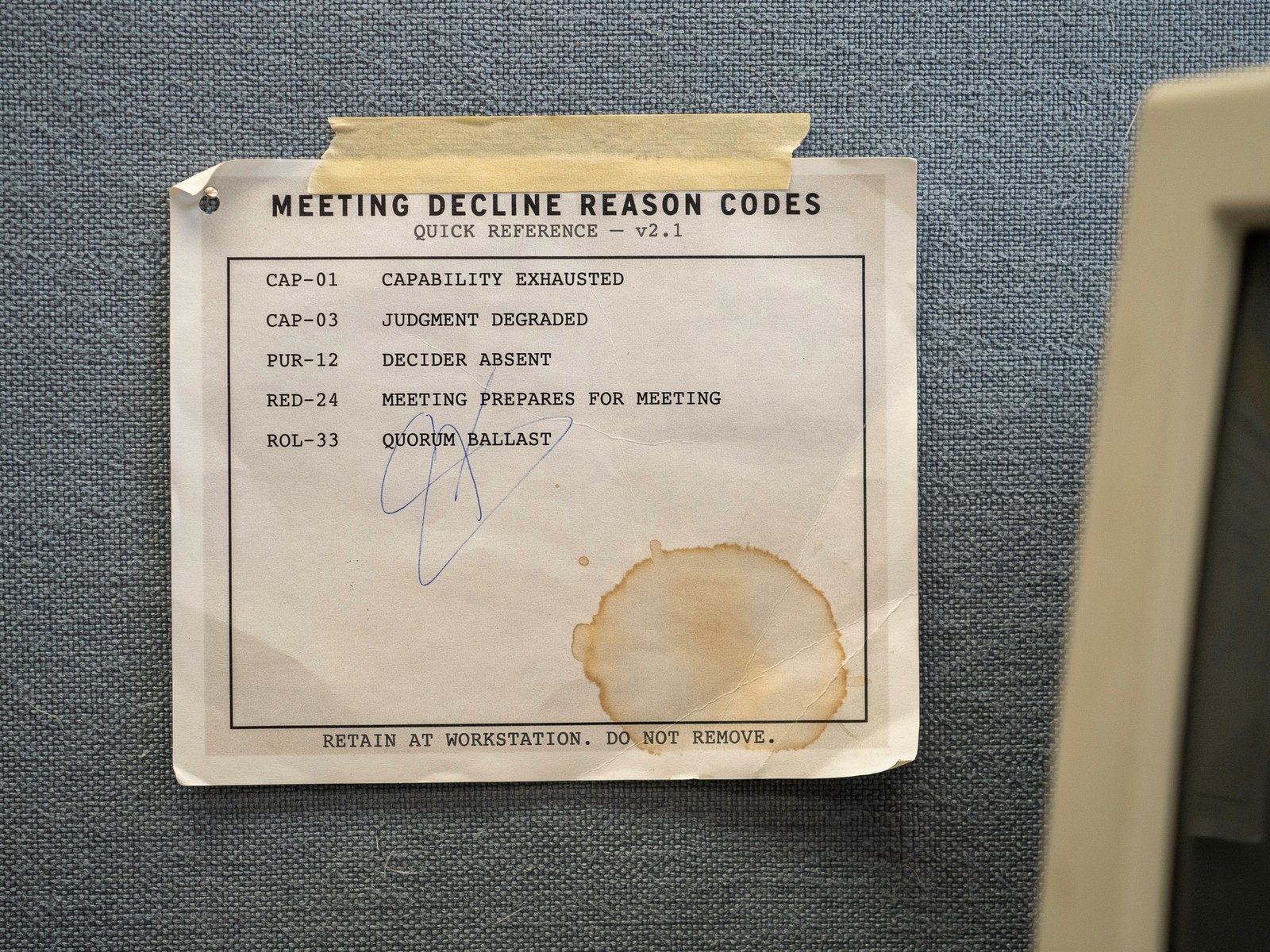
Choice List: MTG_DECLINE_REASON
Choice List Version: 2.2 (unchanged)
Document Revision: 2.2-b
Status: Active
Owner: Workplace Systems / Calendar Governance
Applies to: All exempt and non-exempt staff, all regions
Review cycle: Annual
1. Purpose
This document defines the controlled vocabulary for meeting decline responses. Prior to v1.0, decline responses were free-text. Analysis of the free-text corpus found that 94% of declines resolved to some variant of "conflict," which provided no actionable signal to organizers, capacity planners, or reporting.
Reason codes are mandatory on decline. Selection of a code is not an appeal and does not initiate review.
2. Key
| Symbol | Meaning |
|---|---|
| † | Comment required. Decline will not submit without free text. |
| ‡ | Not visible to organizer. Captured for reporting only; organizer receives a standard decline with no reason string. |
| ◦ | Excluded from decline-rate calculation. |
Symbols are cumulative. PUR-14 †‡ requires a comment that the organizer does not receive.
Document Revision 2.2-b introduces this notation. No field behavior has changed. The flags were previously maintained in a separate section; consolidating them into the entry rows was requested at the v2.2 review after staff reported selecting codes without reference to their handling.
3. Choice List
CAP — Capability
| Code | Label |
|---|---|
CAP-01 |
Capability exhausted — daily acts committed (3/3) |
CAP-02 |
Decision budget depleted — weekly allocation spent |
CAP-03 ‡ |
Judgment degraded — attendance would be nominal |
CAP-04 ‡ |
Attention available, judgment unavailable |
CAP-06 † |
Capacity present but non-transferable to this domain |
CAP-07 |
Capability committed to work arising from prior meeting |
PUR — Purpose
| Code | Label |
|---|---|
PUR-11 |
No decision present in agenda |
PUR-12 |
Decision present, decider absent |
PUR-13 ◦ |
Agenda not published at time of response |
PUR-14 †‡ |
Outcome already determined prior to convening |
PUR-17 ‡ |
Attendance requested for consent, not input |
PUR-18 ‡ |
Stated purpose is visibility |
PUR-19 |
Purpose is alignment; alignment already obtained |
RED — Redundancy
| Code | Label |
|---|---|
RED-21 |
Content available asynchronously |
RED-22 |
Duplicate of standing forum |
RED-24 |
Meeting exists to prepare for subsequent meeting |
RED-25 |
Meeting exists to report on prior meeting |
RED-26 ‡ |
Attendee overlap with prior instance exceeds 80% |
RED-27 ‡ |
Third instance of same discussion in rolling 30 days |
ROL — Role
| Code | Label |
|---|---|
ROL-31 |
Role misidentified — attendee not accountable party |
ROL-32 ◦ |
Accountable party identified; delegating |
ROL-33 †‡ |
Presence requested as quorum ballast |
ROL-35 †‡ |
Attendance requested for optics of representation |
ROL-36 ◦ |
Required attendee list generated from distribution group |
ROL-37 ‡ |
Invited in prior role; role no longer held |
TIM — Time
| Code | Label |
|---|---|
TIM-41 |
Conflicts with protected work — no defensive hold required |
TIM-43 ◦ |
Outside contracted hours |
TIM-44 |
Duration exceeds subject matter |
TIM-45 ‡ |
Scheduled during recovery interval following prior act |
TIM-47 |
Notice period insufficient to prepare stated contribution |
OBL — Obligation Clarification (acceptances)
| Code | Label |
|---|---|
OBL-51 ◦ |
Accepting — no attendance implied |
OBL-52 ◦ |
Accepting — no objection implied |
OBL-53 ◦ |
Accepting — no endorsement of outcome implied |
OBL-54 ‡◦ |
Accepting — capability will be drawn from another commitment |
OBL-55 ◦ |
Accepting — attendance only, no contribution implied |
4. Usage Notes
4.1 The ‡ flag was implemented in v1.4 following feedback that certain codes were being received as commentary.
4.2 All OBL codes carry ◦ because they are acceptances. They were introduced in v2.0 at the request of the Program Management Office to distinguish between the four things an acceptance had previously been taken to mean. A fifth was added in v2.2.
4.3 CAP-01 requires no comment because the daily act count is derived automatically. Staff are not required to maintain the count manually and are advised not to.
4.4 ROL-33 should be selected only where the requirement for quorum has been stated. Where quorum is unstated but inferred, use ROL-35. Both carry †.
4.5 RED-26 is calculated at time of response and cannot be selected manually. It is applied by the system and appears in reporting as a staff selection. The ‡ flag applies to the system-applied value.
4.6 CAP-07 was introduced in v2.2 after capacity planning observed that work generated by meetings was being declined under TIM-41, which classified it as protected work. It is not protected work. CAP-07 allows the two to be distinguished in reporting.
4.7 No code carries all three flags. A code that is both comment-required and organizer-invisible is retained in the decline-rate calculation by design; the comment is the record.
4.8 There is no code for declining because the meeting should not exist. Requests for such a code have been received in each annual review since v1.2 and are logged under Enhancement Request CAL-8817 (Backlog — Not Planned).
5. Deprecated Codes
| Code | Label | Retired | Flags at retirement |
|---|---|---|---|
TIM-42 |
Conflict — other meeting | v2.0 | — |
PUR-15 |
Meeting is theater | v1.3 | — |
PUR-16 |
Meeting is theater (revised) | v1.4 | †‡ |
CAP-05 |
Exhausted | v1.4 | — |
ROL-34 |
Not invited to the meeting where this was decided | v1.2 | — |
RED-23 |
Meeting exists because it exists | v1.3 | ‡ |
Retirement notes
TIM-42 — Retired following Q3 finding that 71% of TIM-42 selections masked capability constraints. Superseded by CAP series. Reporting continuity across the boundary is not guaranteed.
PUR-15 — Retired. Selection volume exceeded configured threshold.
PUR-16 — Reissued at v1.3 with †‡ applied. Retired at v1.4.
CAP-05 — Retired at request of People Operations. Term determined to carry clinical implication. Superseded by CAP-01, which specifies the exhausted resource.
ROL-34 — Retired. Field was being used as a comment box.
RED-23 — Retired. Recurrence with no defined end date is a supported configuration.
6. Revision History
| Version | Change |
|---|---|
| 1.0 | Initial release. 6 codes. Free-text field retained in parallel. |
| 1.2 | Free-text field removed. ROL-34 retired. |
| 1.3 | PUR-15, RED-23 retired. PUR-16 issued with †‡. |
| 1.4 | ‡ flag introduced. PUR-16, CAP-05 retired. |
| 2.0 | OBL series introduced. TIM-42 retired. Decline-rate calculation revised. |
| 2.1 | CAP-04, RED-27, TIM-45 added. No changes to calculation. |
| 2.2 | CAP-07, PUR-18, RED-26, ROL-37, TIM-47, OBL-55 added. No changes to calculation. |
| 2.2-b | Document revision. Flag notation introduced (§2) and applied inline. No field behavior changed. |
7. Reporting
The following reports are generated from this field and distributed on a monthly cycle:
- Decline Rate by Organization Unit
- Top Decline Reasons by Organization Unit
- Decline Rate by Individual (Manager view only)
CAPSeries Selection Frequency — Trailing 90 Days- Organizer Decline Exposure — Trailing 90 Days (pilot)
Reports draw on all selections regardless of ‡ status.
Sustained elevation in CAP series selection is surfaced to the reporting manager as a development indicator.
Retain at workstation. Do not remove.